
 English
 Español
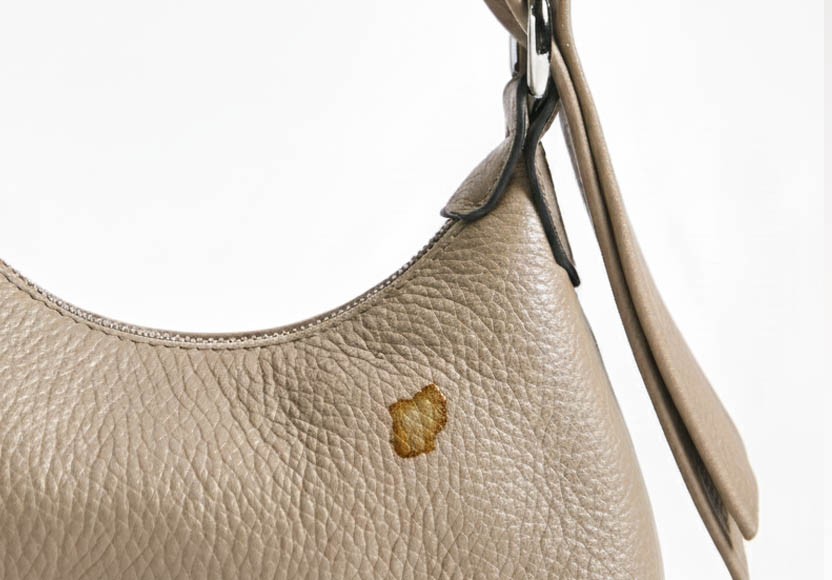
How to remove oil stains from a leather bag: step-by-step (no halos)
Practical guide to remove oil and grease from leather bags without halos: emergency protocol, powder absorption (talc/cornstarch), pH-neutral cleaning, reconditioning and prevention. Includes variations for full-grain vs. suede/nubuck, common mistakes and FAQs.
Introduction
Greasy stains set quickly because they penetrate pores and fibers. The key is not to “scrub hard” but to absorb first and clean with control. With the right order and gentle products, most fresh stains disappear or fade without leaving a ring.
Important: this protocol is designed for genuine leather tanned traditionally (not synthetics). If in doubt, consult a specialist.
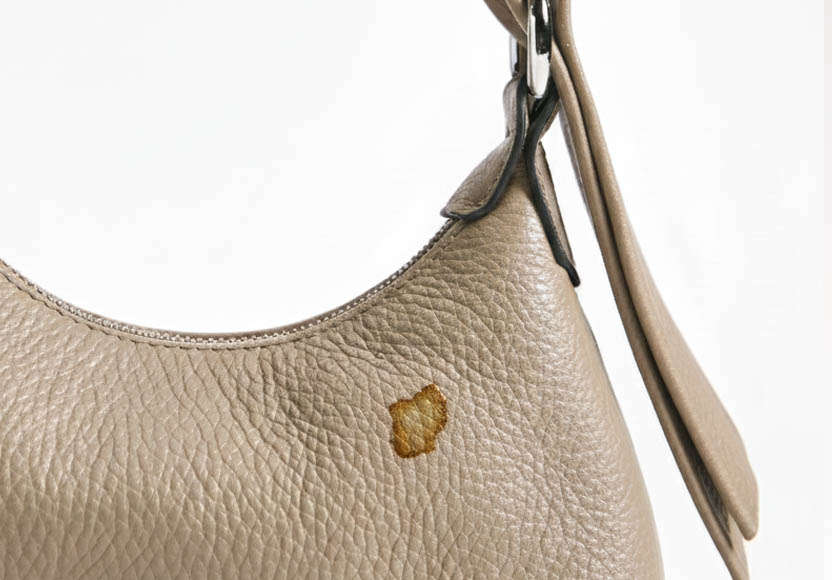
Before you start: identify the leather type
- Full/top grain: natural pores; allows localized cleaning with a barely damp cloth and neutral cream afterwards.
- Suede/nubuck: napped surface; avoid liquids. Work with absorbent powders + brush and consider a professional if the stain is old.
- Sealed/pigmented finishes: better tolerance, but excess soap or friction may leave a halo.
- Golden rule: perform a patch test in a hidden area before any product.
Emergency protocol (0–15 minutes)
- Do not use water or scrub: it will spread the grease.
- Cover the stain with a generous layer of talc or cornstarch (Fuller’s earth/bentonite also works if you have it).
- Let it act for 2–3 hours (fresh stains) or overnight (if it has penetrated).
- Remove the powder with a soft brush or dry cloth. Repeat if it still looks “wet”.
Tip: lay the bag flat so gravity helps the powder do its job.
Method 1 — Repeated absorption (gentle, recommended)
When: fresh stain or visible greasy shine.
- Apply a new layer of talc/cornstarch.
- Wait 2–3 hours and brush off.
- Assess: if the area no longer looks dark/greasy, proceed to finishing & reconditioning.
Why it works: the powder draws lipids out of the pores without wetting or dragging pigments.
Method 2 — Controlled pH-neutral cleaning (full grain)
When: a film or greasy feel remains after Method 1.
Materials: microfiber cloth, lukewarm water, pH-neutral soap (one drop), another dry cloth.
- Moisten the cloth just a little (do not soak). Add a single drop of soap and foam it in the cloth.
- Use short, gentle strokes only on the spot, avoiding seams.
- Remove residue with a cloth slightly dampened with water only.
- Air-dry in the shade; stuff the bag with paper to keep its shape.
Avoid: dish soap concentrates, ammonia or kitchen degreasers.
Method 3 — “Oil-lift” leather cleaner + reconditioning (full grain)
When: a faint ring or uneven feel persists.
- Patch test is mandatory.
- Apply a small amount with a cloth/applicator sponge; work in short circular motions.
- Wipe off as directed and let it dry.
- Apply neutral cream in a thin layer to even out the finish and prevent a matte spot.
Note: oil-lift formulas use mild surfactants; lower halo risk than alcohol.
Variation — Suede/Nubuck (no water)
- Repeat powder absorption until the shine is gone.
- Use a suede eraser with short strokes over the mark.
- Brush in one direction to lift the nap.
- Protect with suede/nubuck spray (thin coats at 20–30 cm).
Do not use: creams or liquids. If a dark shadow remains, consider a professional.
Finishing
- Full grain: after cleaning, apply neutral cream (pea-sized amount per panel) and light buffing to even the sheen.
- Suede/nubuck: after powder + eraser + brush, use protective spray; do not use creams.
Prevention (avoid the next stain)
- Water-repellent spray seasonally (full grain and suedes).
- Avoid resting the bag on bars or kitchen counters with oil residues.
- Carry a mini kit: sachet of talc/cornstarch, small brush and cloth.
Common mistakes (and fixes)
- Scrubbing hard or wetting at the start → spreads the stain.
Fix: go back to Method 1 and absorb first. - Using dish soap or degreasers → overdrying, halos.
Fix: Method 2 with pH-neutral soap and recondition. - Treating suede with water → matted nap, fixed stain.
Fix: powder + eraser + brush; if no improvement, a workshop.
FAQs
Can I use baking soda instead of talc/cornstarch?
It can help, but its grain can be harsher on some leathers. Talc/cornstarch is safer.
Is dish soap okay?
Preferably not: it’s a strong degreaser and may leave a ring and overdry the surface.
What if the stain is old?
Try cycles of repeated absorption followed by a dedicated leather cleaner. Expect a possible faint shadow.
What if the bag is light-colored?
Higher halo risk; work a slightly wider area to blend, then recondition to even the sheen.