
 English
 Español
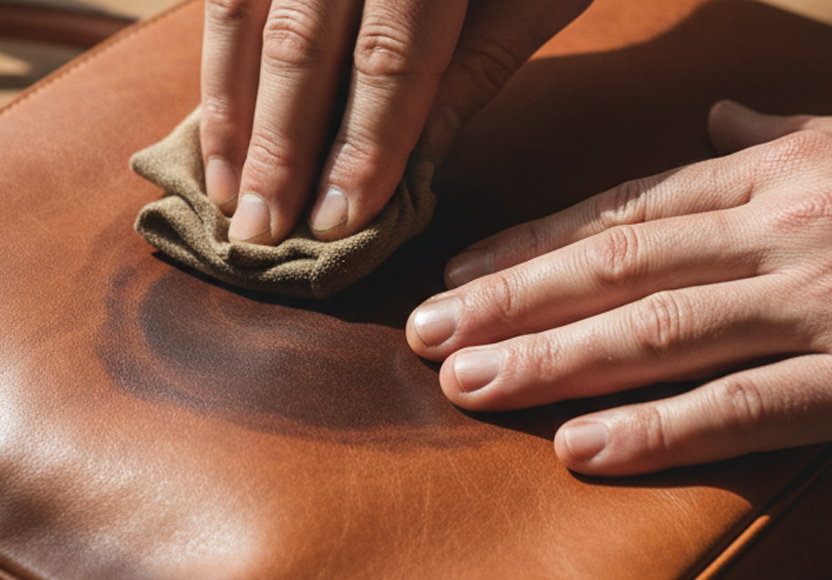
Guide to Removing Water and Rain Marks from Leather Bags
Rain doesn’t damage leather by itself — what truly harms it is incorrect drying. Water evaporates from the edge of the stain, leaving a visible ring or halo. If you control the drying process and balance the moisture, the mark usually disappears or becomes almost invisible.
This protocol applies exclusively to genuine leather.
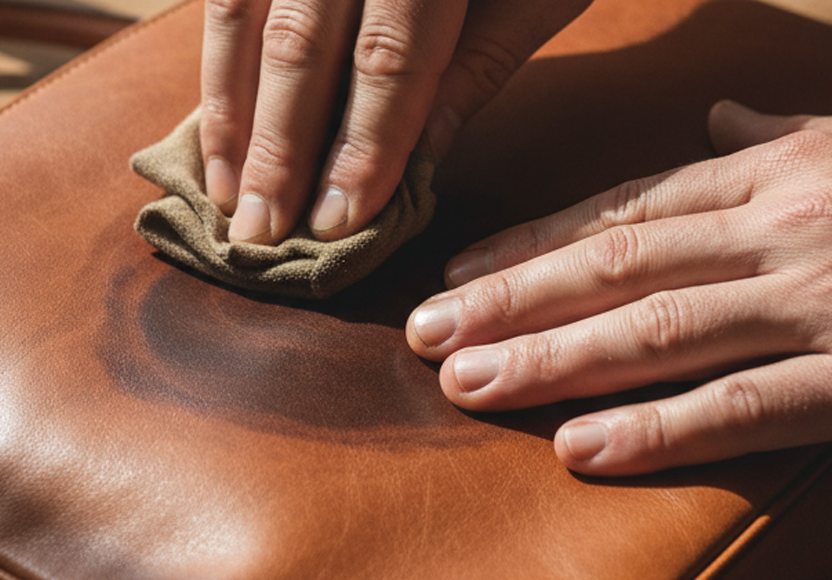
Before you start: identify the material
- Full-grain leather: tolerates a light, even dampening to blend marks, followed by a fine layer of hydration.
- Suede or nubuck: do not wet; work with passive drying, a brush, and protective spray. Water can mat down the nap.
- Sealed or pigmented finishes: more resistant, but heat can set the halo permanently.
- Golden rule: always test on a hidden area before moistening.
First aid (minute 0–5)
- Do not use a hairdryer, heater, or direct sunlight — heat fixes the mark.
- Stuff the bag with paper (not newspaper) to help keep its shape.
- Lay it flat and allow excess water to drain if it’s very wet.
- Blot gently with a microfiber cloth — never rub.
Proper drying (1–24 h)
- Leave the bag in a ventilated, shaded area, away from heat sources.
- Rotate it every 2–3 hours if one side gets more air, to ensure even drying.
- Replace the paper inside if it becomes damp.
Progress sign: the surface looks matte and shows no defined “edge.” If a halo remains after drying, move to the next step.
Balancing moisture to remove the halo (full-grain leather)
Goal: even out the panel so the border of the mark is no longer visible.
- With a barely damp clean cloth, make broad, gentle passes over the entire panel (not just the edge).
- Work in a consistent direction, avoiding seams and edges.
- Let it dry in the shade.
- Repeat once if the halo persists, always with minimal moisture.
Avoid: soaking the panel, using alcohol-based sprays, or scrubbing.
Rehydration and finishing (full-grain leather)
- Once fully dry, apply a neutral cream in a thin layer (about a pea-sized amount per panel).
- Always use products formulated for natural leather — pH-neutral, silicone-free, and alcohol-free.
- Buff gently with a dry cloth to even out the sheen.
- For light-colored bags, work carefully to avoid uneven patches.
Alternative — Suede or nubuck (no water)
- After passive drying, brush the surface gently in one direction.
- If a mark remains, use a suede eraser with short strokes, then brush again.
- Apply a protective spray for suede/nubuck from 20–30 cm away, in thin layers.
Prevention (for next time)
- Apply a water-repellent spray before the rainy season and reapply every 2–3 months.
- For light leather, choose color-safe protectors.
- Carry a light fabric cover bag to protect your leather piece during heavy rain.
Common mistakes (and how to fix them)
- Using heat: fixes the ring. → Let dry in the shade, then balance moisture.
- Rubbing with a towel: lifts color or distorts the grain. → Blot gently instead.
- Over-wetting to “even out”: causes new halos. → Use minimal dampness and broad strokes.
FAQs
Can I use baby wipes?
No — they leave residues and may cause halos. Use a barely damp cloth (for full-grain leather) or a soft brush (for suede).
How long does it take to dry?
Between 8 and 24 hours, depending on humidity and temperature. Avoid speeding up with heat.
What if the bag smells damp?
Air it for 24 hours and use moisture-absorbing sachets. If the smell persists, follow our mold and odor guide.
Will light leather always show a mark?
Not always, but the risk is higher. Work with broad, even passes and rehydrate to even out the surface.